Guided ear exam and at-home diagnosis and treatment for ear infections.

EarRx is a self-led home exam, supported by the EarRx team. You gather a short video and history at home; a board-certified pediatrician reads it and tells you what to do next — treat, wait, or go in.

Launching fall 2026

Not a replacement for emergency care.

What EarRx is

A structured home exam with a physician at the other end.

Three pieces, in this order.

01 · Guided capture

You run the exam at home

A step-by-step video walkthrough teaches you to look inside your child's ear with a consumer otoscope. You record what you see and answer a structured history.

02 · Clinical review

A pediatrician reads it

Your submission goes to a board-certified pediatrician. The same physician who designs our protocols reviews the exam and writes the plan.

03 · A clear next step

Treat, wait, or go in

You receive a written assessment and a specific plan: watchful waiting, a prescription, or a recommendation to be seen in person. If the exam is inconclusive, we tell you that plainly.

Why this matters

Ear infection is the most common reason a young child sees a doctor — and the most common reason they get an antibiotic.

A home exam plus clinician review shortens the path to a correct decision, and shortens the path away from unnecessary antibiotics.

~83%
of children have had at least one episode of acute otitis media by age 3.
Teele DW et al. J Infect Dis. 1989;160(1):83–94.
#1
reason antibiotics are prescribed to U.S. children, per AAP guidance on acute otitis media.
Lieberthal AS et al. AAP Clinical Practice Guideline. Pediatrics. 2013;131(3):e964–e999.
48–72h
AAP's evidence-based observation window for many non-severe AOM cases before antibiotics.
AAP Clinical Practice Guideline, 2013.
Bacteria shift
Since pneumococcal vaccines (PCV13) rolled out, the bacteria most likely to cause an ear infection have changed. That's another reason an actual diagnosis matters more than a reflex prescription.
Kaur R, Pichichero ME et al. Pediatrics. 2017;140(3):e20170181.
How it works

Three steps. No jargon. No black box. Transparent, comprehensible results.

  1. Answer questions in a structured intake

    A short history: age, symptoms, onset, fever, prior episodes, risk factors. The same questions a pediatrician would ask in the room.

  2. Record and upload the exam

    Using a consumer otoscope paired to your phone, you record both ears. The app walks you through positioning, angle, and steadiness, with a short training video to watch first.

  3. Receive recommendations

    A board-certified pediatrician reviews your submission and writes a short, plain-language plan: treat, wait, or be seen in person. If a prescription is appropriate, it's sent to your pharmacy.

What you'll learn along the way

Parents aren't passive consumers of care. We teach you what you're looking at.

01 · Vocabulary

The words your pediatrician uses

TM. AOM. OME. Bulging. Watchful waiting. Knowing the words means you can read the plan and ask the right questions.

02 · Images

What ear-infection findings look like

Normal vs. bulging vs. obscured. We show you what a clinician is looking for and what counts as a real finding vs. an inconclusive view.

03 · Risk factors

What raises a child's odds

Age, daycare, smoke exposure, family history, season. Knowing the risk profile means you understand why a recommendation is what it is.

01 Vocabulary — words your pediatrician uses

TermWhat it means
Tympanic membrane (TM)The eardrum — the thin barrier at the end of the ear canal.
Acute otitis media (AOM)Middle-ear infection with fluid and inflammation; the condition most people mean by "ear infection."
Otitis media with effusion (OME)Fluid behind the eardrum without acute infection signs. Common after AOM; usually doesn't need antibiotics.
BulgingThe eardrum pushed outward by fluid or pus — a core AAP criterion for diagnosing AOM.
Watchful waitingAAP-endorsed approach: in selected non-severe cases, observation for 48–72 hours before starting antibiotics.

02 Images — three things a pediatrician looks for

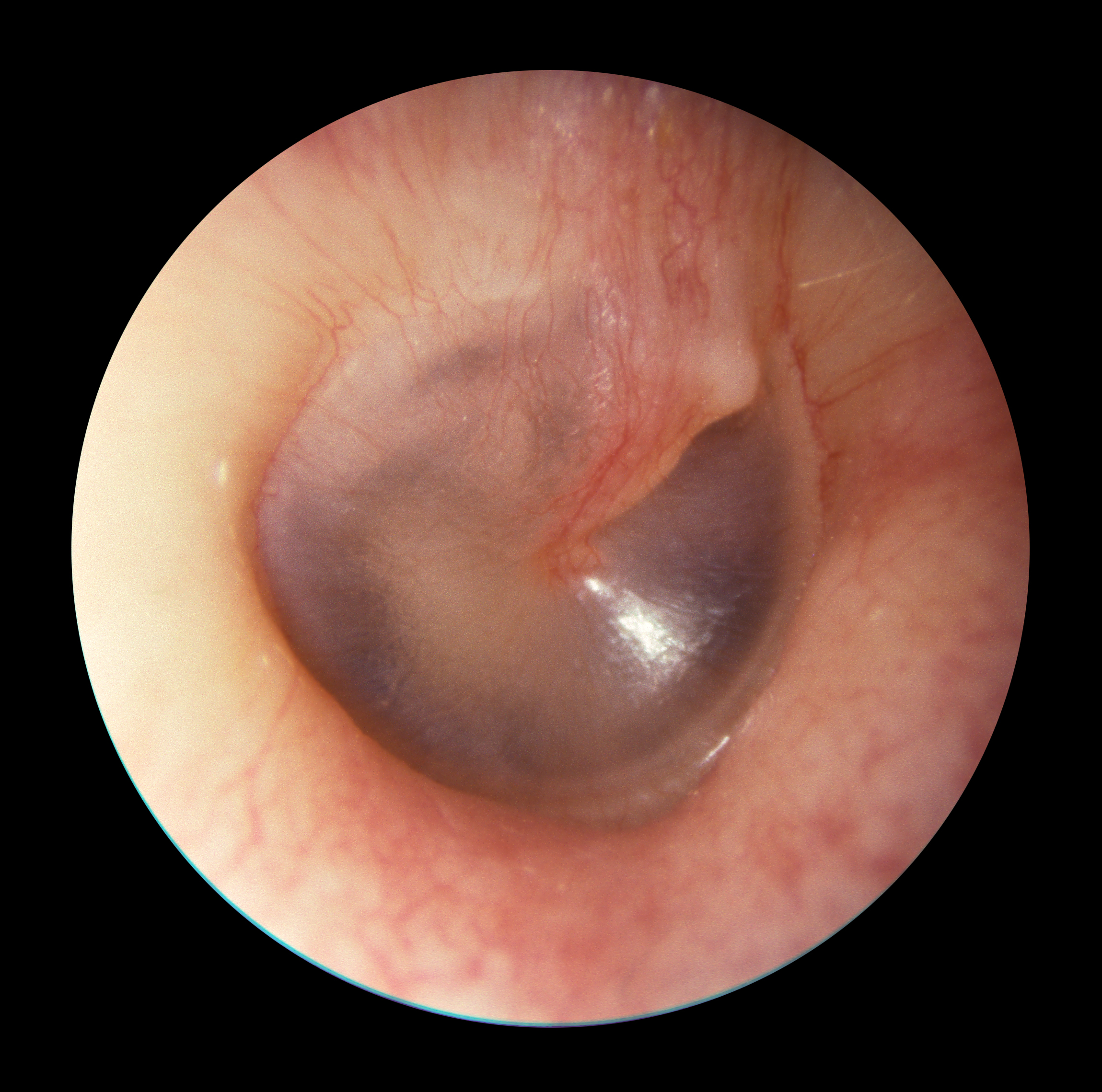
Normal tympanic membrane
Normal — translucent, pearly-gray eardrum. You can see the malleus (the pale bony landmark). Cone of light reflects off the lower front quadrant.
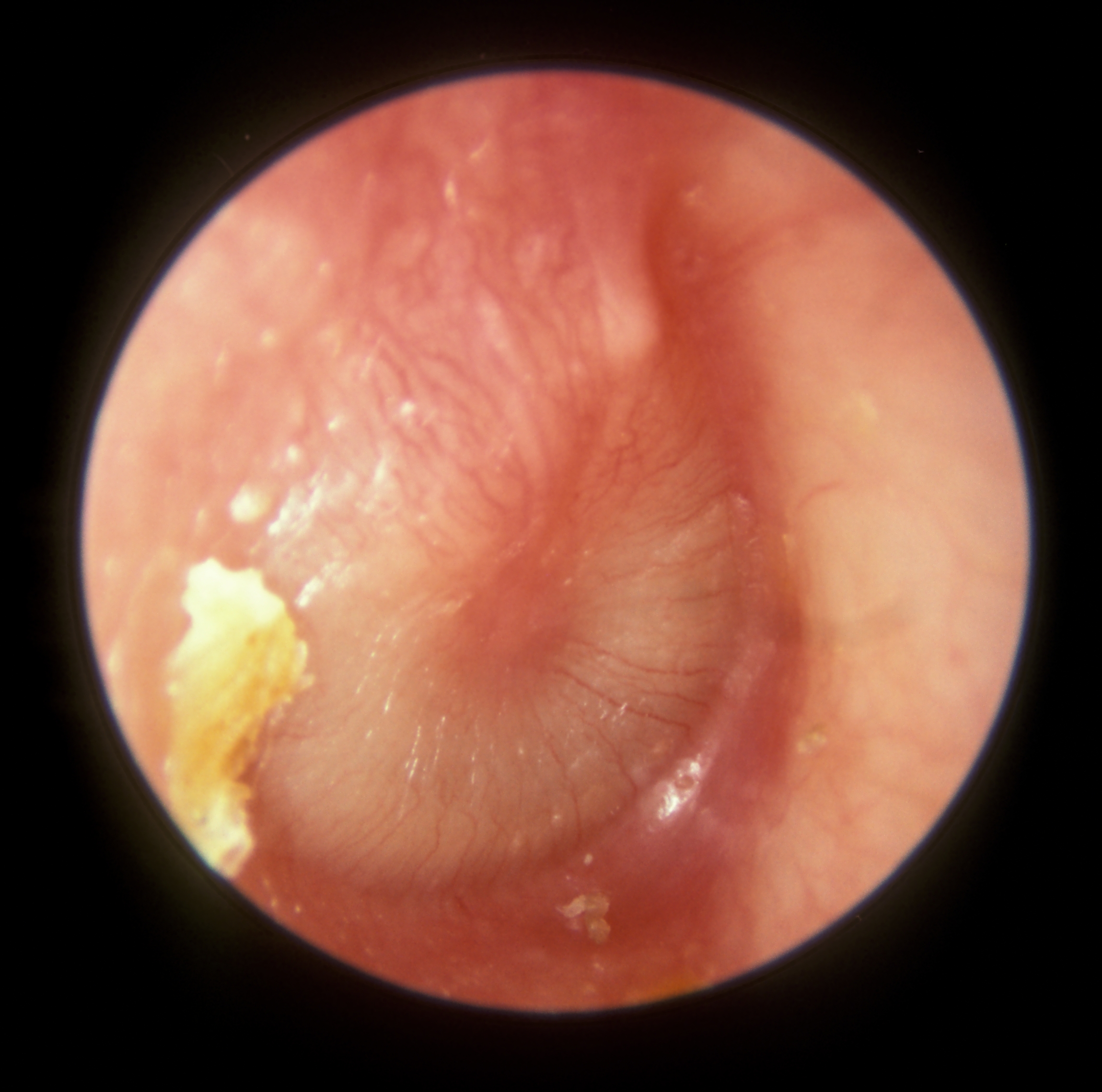
Infected tympanic membrane (acute otitis media)
Infected — an eardrum pushed outward by pus, often red or yellow. On AAP criteria, moderate-to-severe bulging is a hallmark of acute otitis media.
Tympanic membrane with middle-ear effusion
Effusion — clear or amber fluid sitting behind the drum without active infection. Common after a cold and a frequent cause of muffled hearing.

Otoscopy images provided by EarRx clinical team.

03 Risk factors — what raises a child's odds

01

Age under 2

Anatomy and immune development both push incidence higher in this window.

02

Daycare attendance

More respiratory viruses in, more otitis media out.

03

Tobacco smoke exposure

Secondhand smoke is a well-documented modifiable risk factor.

04

Bottle-feeding while lying down

Positioning affects eustachian-tube drainage; feeding upright helps.

05

Family history

Recurrent AOM runs in families. We ask about it in the intake.

06

Seasonality

Rates rise with the winter respiratory-virus season.

Operating principle

No black box.

A physician runs things. You see what we see. The exam is recorded; the rationale is written down; you can read it, ask about it, and share it.

01

A physician makes every diagnosis

Every EarRx recommendation is signed by a board-certified pediatrician. Nothing is auto-diagnosed. Nothing is auto-prescribed.

02

Collaborative care

You see what we see and you understand what we are recommending. The exam, the history, and the plain-language plan are yours to read, keep, and bring to any other clinician.

03

Transparent recommendations

You get recommendations backed by the rationale. When a case is outside scope or the exam is inconclusive, we say so and route you to in-person care.

Clinician review, by design

Safety lives in the workflow, not in a disclaimer.

The protocols below are written into the product, not bolted on.

Every case reviewed

A pediatrician on every submission

Review by a board-certified pediatrician is not optional and not a plan tier — it's the product.

Route-out rules

Automatic escalation for red flags

Severe symptoms, toxic appearance, persistent high fever, facial droop, or very young infants trigger a "go in person" recommendation.

Transparent recommendations

We identify and explain what the history and exam mean

You get a written plan that names the finding, names the reasoning, and names the next step. If wax, movement, or angle make the exam unreadable, we tell you that plainly and route you to a retry or in-person care.

Stewardship

Antibiotics when indicated — not by default

Plans and recommendations follow the latest evidence-based guidelines and best practices, including watchful waiting in appropriate non-severe cases.

About us

Our team.

Rizwan Siwani

Rizwan Siwani

Pediatrician, Mayo Clinic alum, medical informatics expertise.

Matthew Nyman

Matthew Nyman

Strategist, MBA, 10+ years across venture investment and operations.

Emilie Naples

Emilie Naples

Data science pro, M.S. in Big Data Analytics.

Loralee K. Kicker

Loralee K. Kicker

20+ years in revenue growth and automation.

Pricing

Transparent pricing.

Otoscope

One-time
Bring your own, or pick from a list we've vetted.

Single visit

Per exam
One submission, one physician-reviewed plan.
  • Board-certified pediatrician review
  • Written plan with clear next step
  • Prescription if appropriate
  • No subscription, no membership
FAQ

Straight answers.

Is this a replacement for the pediatrician?

No. EarRx is a physician-led service for common pediatric ear concerns. For emergencies, complex illness, or anything outside ear-related symptoms, you should see your regular pediatrician or go to urgent care / the ED.

Who reads my child's exam?

A board-certified pediatrician. Every submission is reviewed by a physician. The recommendation is signed by that physician.

What if the exam isn't clear enough?

We tell you. If wax, angle, or movement make the image unreadable, the physician marks the exam inconclusive and routes you to a retry or in-person care.

Can you prescribe antibiotics?

When indicated, yes — following the latest evidence-based guidelines on acute otitis media, including watchful waiting for appropriate non-severe cases.

Do I need a special device?

A consumer otoscope that pairs with a phone. We support a small list of vetted devices and will offer a bundle at launch for families who'd rather buy through us.

Where are you launching?

Minnesota first, with additional states to follow. Waitlist members will be notified as we open their state.

Join the waitlist.

Sign up here. We'll email you when EarRx is live in your state. No spam, no selling your data, unsubscribe anytime.

By submitting your email you agree to our privacy policy. We use your email only to notify you about EarRx.

References
  1. Lieberthal AS, Carroll AE, Chonmaitree T, et al. The diagnosis and management of acute otitis media. Pediatrics. 2013;131(3):e964–e999.
  2. Teele DW, Klein JO, Rosner B. Epidemiology of otitis media during the first seven years of life in children in greater Boston. J Infect Dis. 1989;160(1):83–94.
  3. Kaur R, Morris M, Pichichero ME. Epidemiology of acute otitis media in the postpneumococcal conjugate vaccine era. Pediatrics. 2017;140(3):e20170181.

The stats on this page come from the references above.